Saint Mina Church Saint Mina Church
Donate
  • Home
  • Donate
  • Services
    • Liturgy Registration
    • Newsletters
    • How to Read Coptic
    • Competitions
      • COOL 2022
      • COOL 2021
      • COOL 2020
      • Philly 2020
      • Coptic Hymns 2019
      • Coptic Hymns 2018
      • Coptic Hymns 2017
    • Forms
    • Sunday School
    • Calendar
      • Liturgical
      • Livestream Calendar
    • St. Joseph Meeting
    • St. Paul Disciples Preparatory Class
  • Our Church
    • Announcements
    • Directions
    • Faith, Truth & Life Convention
  • Coptic Orthodox
    • Coptic History
    • Pope Shenouda III
    • Monasticism
      • Articles
  • Resources
    • Downloads
    • Upload
    • Events Gallery
    • Live Stream - Main
    • Media Library
  • Search

St. Abanoub

Details
Saint Mina Church
Uncategorised
31 August 2026
Hits: 34

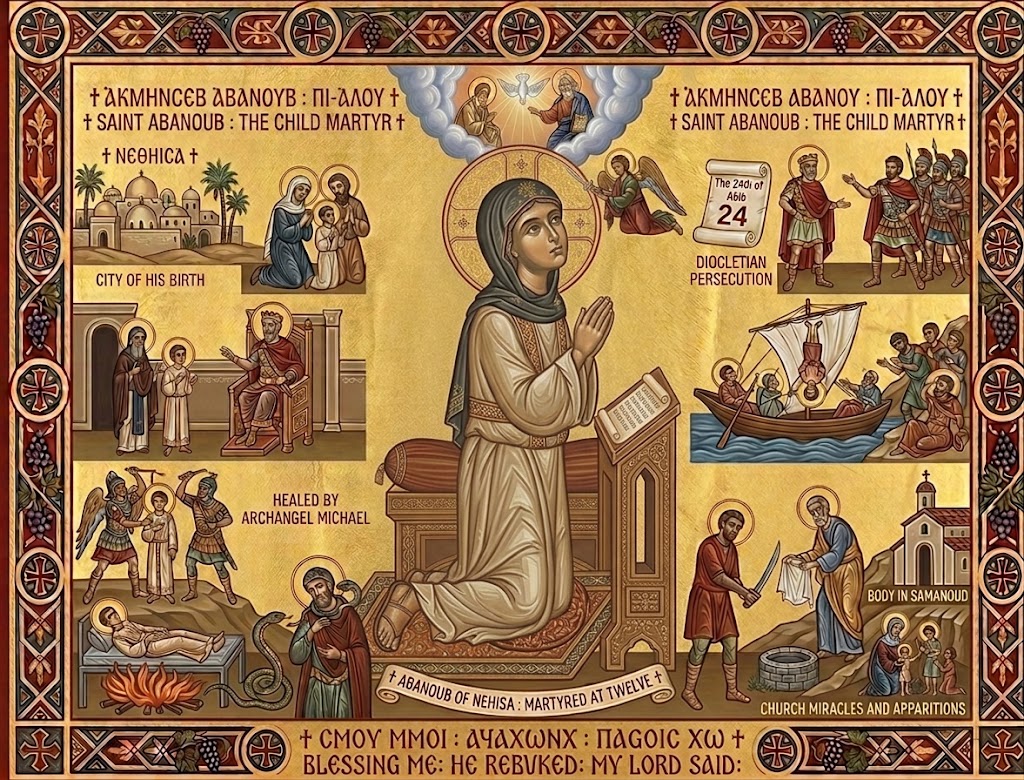
On the 24th of Abib, St. Abanoub  was martyred. He was born in the city of Nehisa (District of Talkha). His parents were pure and merciful and they reared him in the fear of God. When he was martyred by the Roman rule, Diocletian, who incited the persecution against the Christian, St. Abanoub was twelve years old, and he desired to shed his blood for the Name of Christ. On July 31 our Church celebrates his death, as the day of his birth into eternal life. Abanoub's relics, as well as the relics of many Christians who died with him, are still preserved in St. Virgin Mary and St. Abanoub church in Samanoud.

It is also said that the Holy Family visited that place during their Flight into Egypt. The church still contains the well from which The Lord Jesus, St. Mary, and St. Joseph drank. Numerous apparitions and miracles do occur in that church until this very day. Abanoub was born in a town called Nehisa in the Nile Delta. He was the only son of good Christian parents who died when he was a young child. At age twelve Abanoub entered the church to hear the priest asking the congregation to remain faithful during the persecutions provoked by Diocletian, the Roman emperor.

Read more: St. Abanoub

Saint Stephen: The First Martyr

Details
Saint Mina Church
Uncategorised
31 August 2026
Hits: 39

By Andrew Gueruis

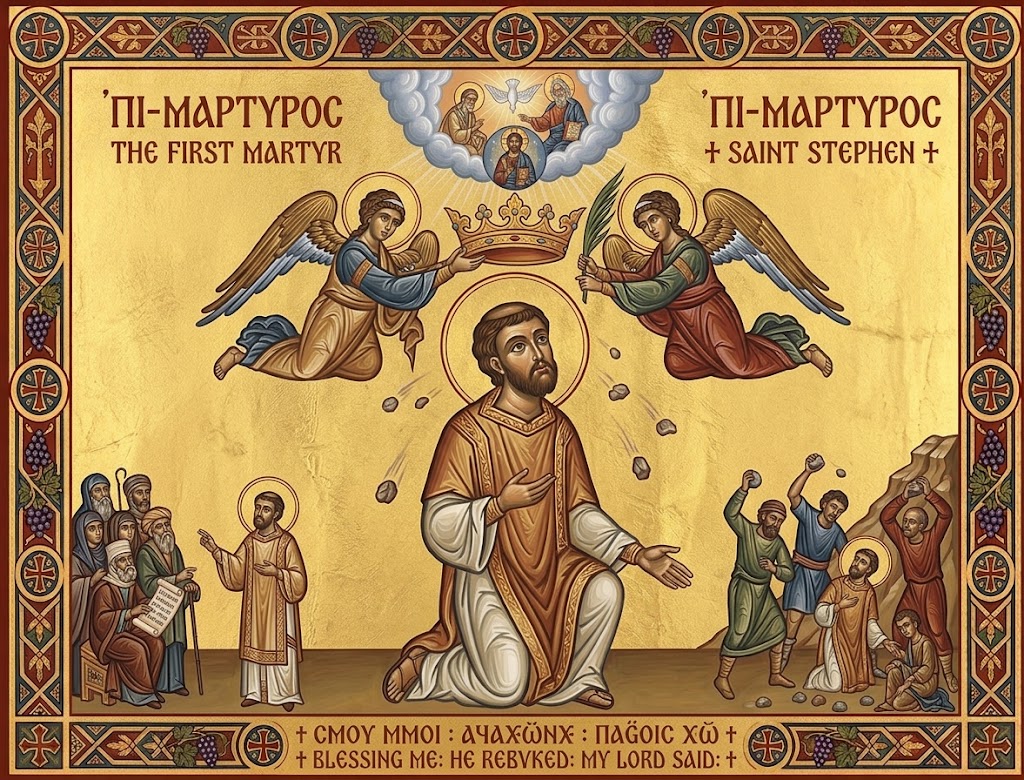
Today, I will take you on a journey in the life of one of my favorite saints. This saint was a young man who was filled with the Holy Spirit, faith, and power. His life is very unique and it shows us how we should be as Christians, and how our lives will be filled with joy and peace when we know God. By now you are probably saying to yourselves, “but isn’t this all saints,” well in generalization about saints, yes, however this saint is different. His story is written, even in the Bible and documented in the Book of Acts and the Synaxarium of the Church. Hopefully you know who this saint is, if not, allow me to tell you. The story of St. Stephen takes place when the number of the disciples was multiplying and they chose him to serve. “Then the twelve summoned a multitude of the disciples and told them ‘It is not desirable that we should leave the word of God and serve tables. Therefore, brethren, seek out from among you seven men of good reputation, full of the Holy Spirit and wisdom, whom we may appoint over this business; but we will give ourselves continually to prayer and to the ministry of the word’” (Acts 6:2-4)

Read more: Saint Stephen: The First Martyr

The Apostles’ Fast

Details
Saint Mina Church
Uncategorised
31 August 2026
Hits: 40

By: GEORGE YOUSSEF

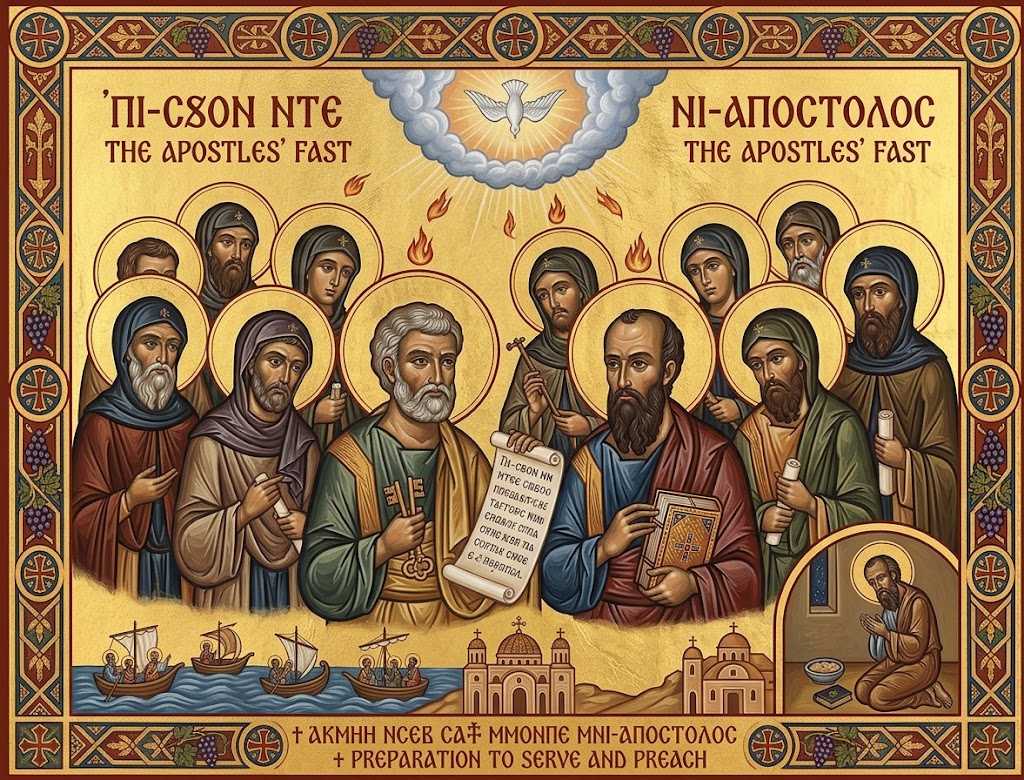
The Apostles’ fast which concludes on July 11th. This fast precedes the Apostles’ feast on the fifth day of Epip, the day St. Peter and St. Paul were martyred.  Through the Apostles’ fast, we thank God for the gifts of the Holy Spirit on the day of Pentecost, we acknowledge the struggles and tribulations of the holy apostles as they preached and established the foundation of the Christian church, and we prepare ourselves to serve and preach. This fast reflects the fast the apostles took on after the descent of the Holy Spirit upon them on the day of Pentecost. Just as Our Lord fasted for forty days in the wilderness following the descent of the Holy Spirit upon Him during the Theophany, the holy apostles too fasted when the Holy Spirit descended upon them.

To this day, we apply the wisdom of the holy apostles to our

Read more: The Apostles’ Fast

The History of the Coptic Church, Part I

Details
Uncategorised
30 August 2026
Hits: 13

Written by: Dr. Medhat Ibrahim, Seminarian Deacon, Theological College, El-Mina, Egypt

It has been said that a nation without a history is a nation without a future. Let us thank God for the history of our Coptic Church written in the blood of our Fathers who were martyred to preserve the faith they ardently confessed.

The Origin of Egyptians

The first to settle in the land of the River Nile’s Valley was “Egypt”, the son of Ham, the son of Noah. Egypt and his children including Asian tribes came to the Nile River Valley through the Suez isthmus and settled there. Thus the land became known as “Egypt” and the people Egyptians.

In the Old Testament, the Nile Valley was also called Egypt. However, in Coptic language, it was called “Kimy” which is derived from Ham, the father of Egypt, or may be derived from “Kam” which means black referring to the color of its land.

Later on, the Greeks called the Nile Valley “Algyptos” which was derived from the hieroglyphic word “HAKAPTAH” which is the “GOS PTAH of Minf”, the capital of ancient Egypt.

When Islamic Arab occupied Egypt, they called it “Kift” which is the nearest city to the Red Sea and means “Home of Coptic’s”, so the words “Coptic” and “Egyptian” have the same meaning.

In Egypt, many cultures were established since 5000 BC to the time of the first family at 3200 BC. Before the time of families, Egyptians invented the hieroglyphic language, which was first expressed by pictures. Then the hieroglyphic alphabet was written. Also, Egyptians invented the solar calendar system during the time of King Zoser of the third family upon the counseling of his minister “Imhotb.”

The Time of Families

An ancient Egyptian priest called Maniton (280 BC) recorded the history of ancient Egypt and the time of families that governed Egypt unto “thirty” families beginning with the first family and ending with the thirty families during the time Alexander the Great occupied Egypt in 332 BC. All writings of Maniton were preserved in the Library of Alexandria that was burned in the seventh century. Also most of the events and families of ancient Egypt were recorded on the walls of the temples.

The first king of the first family was the King Mena who united upper and lower Egypt under one authority and one central government. This was the first government the world knew existed.

The Old Nation State (2780-2280 BC) includes the families from the second to the tenth. The capital of Egypt was Manif. The first king of the third family was Zoser. The first king of the fourth family was Sinfro. Its kings also were Khofo, Kfefra, Mankara who were the builders of the pyramids of Gaza.

The Middle Nation State (2280-1567 BC) included the families from eleven to seventeen. During the time of the 12th family, our father Abram visited Egypt as it was recorded on the walls of the temples. Asian tribes came to Egypt asking for food during starvation in Palestine (Genesis 12: 10-20).

In 1675-1567 BC Hexos came from Asia and occupied Egypt. The tribes became known as “Shepard kings.” During their time, Joseph, the son of Jacob, reached his prestige as the second in command of Egypt. Also during this time, Jacob and his sons came to Egypt and settled in the Land of Goshen near Afras City, which was the capital of Hexos kings, the governors of Egypt.

The Recent Nation State (1567-1085 BC) included 18th, 19th, and 20th families. The first king of the 18th family was Ahmos the 1st that drove Hexos out of Egypt (1570-1547 BC). Ahmos was the king who didn’t know Joseph as mentioned in the Holy Book of Exodus (1:8). During this period of time, God delivered the Israelites out of Egypt through the Passover. The king during that time was the King Ammohotob, II reigning in the middle of the 15th century before the birth of the Lord Jesus Christ as mentioned in the Holy Book of Exodus (2:15).

The Late Families Era (1085-332 BC) included the families from the 21st to 30th families when Alexander the Great occupied Egypt. From the 21st family, Solomon, the King, married an Egyptian princess who was the daughter of the king of Egypt at that time, Opsosms (525 BC).

Persians occupied Egypt establishing the 27th family. At the end of the Persian occupation, the Egyptian princess established families 28, 29, and 30 in Upper Egypt until Alexander the Great occupied Egypt in 332 BC.

Alexander the Great (332-330 BC) drove the Persians out of Egypt with military force. Alexander the Great established the City of Alexandria on the Mediterranean Sea. After the death of Alexander in Babylon in 330 BC, his empire was divided into states for his generals. Egypt was under the authority of Patlimos, the First, who established The Library of Alexandria. The Old Testament was translated into the Greek Language by 70 Hebrew priests that became known as the Septuagint (the word means seventy).

The Roman Invasion (31 BC)

The Roman Senate Council sent a fleet under the leadership of Octavian, which met the fleet under the leadership of Mark Antony and his friend Cleopatra, the Queen of Egypt in Ektioum on the coast of Greece. In this war, Octavian defeated Mark Antony and Cleopatra. Mark Antony and Cleopatra then escaped to Alexandria.

In Alexandria, Cleopatra accepted the suggestion of Octavian and killed her friend Mark Antony. From that time, Egypt became a Romanian state. Octavian changed his name to Augustus Caesar in 27 BC and became the highest governor of the Roman Empire. During Augustus time, our Lord Jesus Christ was born of St Mary, the holy virgin, by the Holy Spirit.

When Augustus Caesar occupied Egypt and added it to the Roman Empire, its population was 8 million and its capital was Alexandria. Although most Egyptians at that time were native Egyptians and spoke the Coptic language, the governors’ tribunal was formed of Greeks and Jews who spoke the Greek language and had a limited relationship with the native Egyptians.

Egypt was the breadbasket for Rome. Wheat was the most important crop grown in Egypt and presented to Rome. Rome’s population was near one million and as the food shortage in Rome grew, the empire needed Egypt’s exports. Due to the fear of riots which almost always followed food

shortages, the emperor Augustus gave the order to the governor of Egypt to send a shipment of wheat to Rome every year whose average was “850,000 ardbs” (Egyptian measure of wheat).

The Emperor Augustus gave the Jews of Alexandria Roman citizenship as they also did the Greeks. Thus, giving them freedom of worship and their own judiciary. In fact, the Jews at that time were great in number and education as reported in the Holy Book of Acts (6:9). So it was expected that the Holy Family during its presence in Egypt would stay with Jewish colonies, which had settled in Egypt at that time.

Emperor Augustus divided Egypt into 3 administrative divisions; Upper Egypt, Middle Egypt, and Lower Egypt (the Delta of the Nile River). An administrative governor without any military power governed each division. Each was under the direct leadership of the Emperor. Emperor Augustus built many successful projects in Egypt such as Roman camps, new water reservoirs, new roads, and the digging of new water channels that would eliminate mud making to make the land more productive for cultivation.

By this brief description, it would appear that the Romans established a good administrative authority and successful engineering of projects throughout the land overall producing great quantities of food for Rome. However, it brought about social and economic failure in Egypt among most of the Egyptians who were the true owners of the land.

It was at this time, that many Egyptian cities and villages were blessed by the visit of the Holy Family in its flight from Palestine, escaping the unfair rule of Herod, the King.

Prophecies of the Old Testament About Egypt and Egyptians

The Holy Bible did not talk about any nation more than Egypt except Jerusalem that is the symbol of Heavenly Jerusalem. This is because of the staying of the Jews in Egypt for 430 years as it is written in the Holy Book of Exodus (12:40-41), then God by His strong and Almighty hand took them out safely through the blood of the Passover’s lamb which was a symbol of the Lord Jesus Christ’s blood and this occurred on the night of 15th of the Hebrew month, “Nissan.” By this, the Israelites became free from the devil’s power through the Lord Jesus Christ’s blood of which the lamb’s blood became a symbol of general world power and the house of slavery from which God delivered His people.

Inspiration About Egypt

This is a message about Egypt. “The Lord is coming to Egypt, riding swiftly on a cloud. The Egyptian idols tremble before Him, and the people of Egypt lose their courage” (Isaiah 19:1).

“When that time comes, there will be an altar to the Lord in the land of Egypt and a stone pillar dedicated to Him at the Egyptian border. They will be a symbol of the Lord God Almighty’s presence in Egypt. When the people there are oppressed and call out to the Lord for help, He will send someone to rescue them” (Isaiah 19:19-20).

The luminous soft cloud, which our Lord Jesus Christ was riding, was His mother, St Mary, the Virgin, who is more than the clouds in her purity and holiness. The altar is the Christian Church, which was built by St Mark, the Apostle, instead of idols that were destroyed in front of our Lord Jesus Christ when He came to Egypt with the Holy Family. This altar is the monastery of El Mohark in Assuit governate, which is the midpoint of Egypt from north to south and from east to west. In the monastery

of El Mohark, also known as the Monastery of St Mary, the Virgin is an altar upon which the Divine Liturgy is prayed every day, which is the extension of the cross’s sacrifice. By this we see that the prophecy of Isaiah had come to be.

Egypt was the Refuge and Shelter for the Hungry and Persecuted

Our father Abraham went to Egypt because of severe starvation in the land of Israel (Genesis 12:10). When his brothers persecuted Joseph he found himself in Egypt eventually second in command to the pharaoh himself. Our father Jacob came with his children because of severe starvation in Canaan (Genesis 42-47) and there they became a great people. God sent them Moses to be their leader and his brother Aaron to be the first priest and right hand for Moses to deliver the Israelites out of Egypt after their staying there about 430 years.

Jeremiah the Prophet, willingly came out of Egypt to accompany the Israelites after encouraging his people to not escape to Egypt. The Lord spoke to Jeremiah (Jeremiah 43:8 and 44:3) about all the Jews residing in Magdal, Nof, Tahfanis, and fetors land.

Then the Holy Family came to Egypt escaping from Herod, the King, and visited many Egyptian cities and villages in the North and South of Egypt as said by Hosea the Prophet, “The Lord says when Israel was a child I loved him and called him out of Egypt as my son” (11:1). So St Matthew, the Apostle, considered this prophecy was special to the Lord Jesus Christ that had been done with His blessing coming with the Holy Family to Egypt and establishing the Christian Church in Egypt by St Mark, the Apostle, as inspired by Isaiah the Prophet. “The Lord will reveal Himself to the Egyptian people and they will acknowledge and worship Him and bring Him sacrifices and offerings” (Isaiah 19:21) and “The Lord Almighty will bless them and say I will bless you, Egypt, my people” (Isaiah 19:25).


Source: Coptic Orthodox Metropolis of the Southern United States.

Download the original PDF

The History of the Coptic Church, Part II

Details
Uncategorised
30 August 2026
Hits: 10

Written by: Dr. Medhat Ibrahim, Seminarian Deacon, Theological College, El-Mina, Egypt

When our Lord Jesus Christ was born, the Roman Empire extended for about two thousand miles in width from the Antonios Wall and the northern borders of France to the Atlas Mountains and the Tropic of Cancer, known as the “Cancer Latitude.” The Roman Empire extended for about three thousand miles in length from the Atlantic Ocean to El.Frate River.

The Roman Empire was one of the most beautiful regions in the world between the lines of 24 and 56 to the North and surface area of one million, 600 thousand square miles. Most of this surface area was excellent cultivated land. During this era Alexandria, Rome, and Athens were the most important cities in the world.

Egypt during this time was a Roman state under the direct authority of Roman Caesar. Also a Mediterranean state, Egypt was self-supporting. The production of wheat, linens, and cotton was unsurpassed. Egypt exported many products to approximately 100 countries, including Rome, the capital of the Roman Empire. Even with the abundance of exports, native Egyptians had limited freedom due in large part to the many dominating nations who settled there throughout history.

Egypt during the time of the Roman Empire included 3 divisions and about 36 states. The Greek language was the most frequently spoken. Egypt was the “bread basket” for the Empire. It was first among the other states, in industry and trade.

Alexandria, the capital of Egypt, was renowned for its great architecture, stately museums, temples, and its famous Library and University. The Alexandrian Library was one of the 7 wonders of the world. The City of Alexandria was divided into 5 sections containing official government buildings, which included that of the Roman governor. This section included people of Greek, Jewish, Roman, Persian, Syrian, and Egyptian lineage. As mention by Philo, at the time of our Lord Jesus Christ, about 40% of the Alexandrian people were the rich Jewish who worked in industry and trading. This may explain why the Holy Family fled to Egypt.

The Birth of Our Lord Jesus Christ

As mentioned in the Holy Gospel of St Luke 2:1-7, “And it came to pass in those days that a decree went out from Caesar Augustus that the entire world should be registered. This census first took place while Quirinius was governing Syria. So all went to be registered everyone to his own city. Joseph also went up from Galilee, out of the city of Nazareth, into Judea, to the city of David, which is called Bethlehem, because he was of the house and lineage of David, to be registered with Mary, his betrothed wife, who was with child. So it was that while they were there, the days were completed for her to be delivered. And she brought forth her firstborn Son, and wrapped Him in swaddling cloths, and laid Him in a manger because there was no room for them in the inn..”

It is known that a general census took place every 14 years in the Roman Empire (included were Egypt, Syria, and Palestine). In Syria, the census first took place at the time of Kerenlios, governor of Syria. During this period of history, Herod was the king of Judea and Augustine was the Roman Caesar.

The calendar utilized in Rome at that time was related to the foundation of Rome and its symbol was “Announbis conditae A.V.C.” Dionysuis Eyiguus later changed this to the Christian calendar on 526 AD and its symbol was Anno Domini (A.D.).

However, we believe Dionysius to be inaccurate with his calculations by approximately 4 years as he calculated the birth of the Lord Jesus Christ on 754 A.V.C., but Herod, the Elder who killed Bethlehem’s children died on April 750 A.V.C. and so if we add 3.5 years, the duration of the presence of the Holy Family in Egypt according to Coptic history to the date of the death of the king, Nero which was on 4 B.C. We further know that the Lord Jesus Christ was born in 7 B.C., which is the same time at which Kerenlios was the governor of Syria.

A papyrus, dating back to the 4th century, which was studied in Kilon University, Germany, revealed that the Holy Family stayed about 3 years and 11 months in Egypt. The papyrus was written by Fayoum in Coptic dialect and mentioned that the Month of Bashans was the most blessed month of the year. Therefore, our beloved Coptic Church celebrates the Feast of the Holy Visit to Egypt on the 1st of June each year.

The Blessed Lord Jesus Christ’s Birth and the Scientists of Astronomy

The scientist Johannas Kepler in 1603 observed that Saturn and Jupiter in the whale’s group become very close together and appear as one star. Kepler reviewed the writings of Jewish author Abravanel who mentioned that the Messiah would appear when Saturn touches Jupiter in the whale’s group and so according to the statistics done by Kepler, he noted that this occurred in 7 B.C. The year of the Lord Jesus Christ’s birth was 7 B.C.

Also in l925, the German scientist Schnabel read the writings before the Babylon Era, which belong to the Sippar’s Astronomy School in Babylon, Egypt. These writings predicted that Saturn and Jupiter would become very close in 7 B.C. This explains the trip of the Wise Men from the East to Jerusalem.

The Christian History

As previously mentioned, Dionysius Exiguous was the first in 526 AD to use the Christian calendar. Exiguous purported that the Lord Jesus Christ was born on December 25, 753 A.U.C. However, as all scientists know Exiguous made a mistake in his calculations. By the comparison of the Holy Gospel of St Matthew 2:1 and the Holy Gospel of St Luke 3:1 we can accurately conclude the following: The Lord Jesus Christ was born before the death of Nero who died the spring of 750 A.U.C. As denoted by Yousifous, the Lord Jesus Christ began His preaching at the time of sharing Tebarious Caesar with Augustine Caesar on 765 A.U.C. This signifies to us that when the Lord Jesus Christ was 30 years of age, Tebarious Caesar had 15 years in authority, and with the addition of these 15 years to the beginning of Tebarious authority, we can conclude that the Lord began His earthly ministry on 779 A.U.C. This further proves that He was born on 749 A.U.C. approximately 4 years before the date mentioned by Exiguous. Being impossible to correct on the Christian Calendar, scientists added the years to the period between Adam and the Lord Jesus Christ to be 4004 instead of 4000. Can you then calculate the date of the Lord Jesus Christ’s birth to have been on December 25 or January 7?

As written in the Apostolic Teachings, chapter 18, “you should celebrate the Feast of the Lord’s birth on the 25th of the 9th month for Hebrew which is the 29th of the 4th month for Egyptians.” The Hebrew year is less than the Coptic Year by 11 days. The Hebrew Year also depends on the moon’s movement

while the Coptic Year depends on the solar system. Therefore, one month every three years was added to the Hebrew year to coincide with the solar calendar.

When the Romans designed their calendar which also depended upon the solar system, their calendar started with January and ended with December and so December becomes similar to the 9th month of the Hebrew Year and the 4th month of the Coptic Year so December 25th equals the 25th of the 9th month of the Hebrew Year and 29th of the 4th month “Kiahk” of the Coptic Year as denoted in the Apostolic Teachings.

In 1082 AD, Pope Gregory 13th, observed that the solar calendar is 365.2422 and not 365.25 as was known so Pope Gregory did the “Gregorian Correction” where the difference 0.0078 day/year for one day every 128 years so he added 13 days placing 29th Kiahk on January 7 and every 128 years, the difference will increase by one day so 29th of Kiahk will be 8th of January 2101 AD and the 9th of January on 2229 and so on.

The Flight of the Holy Family From Bethlehem to Egypt

The Holy Gospel of St Matthew 2:13-15 states, “Now when they had departed, behold, an angel of the Lord appeared to Joseph in a dream, saying, ‘Arise, take the young Child and His mother, flee to Egypt, and stay there until I bring you word; for Herod will seek the young Child to destroy Him.’ When he arose, he took the young Child and His mother by night and departed for Egypt, and was there until the death of Herod, that it might be fulfilled which was spoken by the Lord through the prophet, saying, ‘Out of Egypt I called My Son.”

  1. The Holy Family in Bethlehem: After St Joseph had received instruction from the Angel of God to take the young Child, the Lord Jesus Christ, and His mother and flee to Egypt; he also took Salome, a mid-wife. The Family stayed for a while in a grotto, known by Bethlehem residents as “Magharat El-Sayyidah or Magharat El-halib” situated southeast of the Basilica of Nativity.

The Armenian tradition asserts that when St Mary the Virgin tried to beast feed the child, Lord Jesus, drops of her milk fell upon a stone that became white. St Paula built a church upon this site in the name of the Virgin, St Mary. This grotto is filled with white soft stones known as the “virgins’ milk.” Some of the stones were transferred to Europe for the building of churches there. The present Basilica was built in 1872 AD and its stones have the power to stimulate the flow of milk in lactating females.

The Holy Family in its trip to Egypt used a donkey. In the Holy Gospel of St Matthew 21:5 we read “Tell the daughter of Zion, ‘Behold, your King is coming to you, lowly and sitting on a donkey, A colt, the foal of a donkey.”

  1. The Holy Family in the Land of the Philistines: The Holy Family went first to the ancient Philistine city and seaport of Ashkelon on the Mediterranean Sea where Samson killed thirty Philistines (Judges 14:19). From there, they proceeded in an almost easterly direction to Hebron. Then they traveled to Gaza about 40 km to the west, where the site of the ancient Canaanite stronghold of Gaza was. They took the route that ran parallel to the shore of the sea, and crossed the Valley of Gaza in about two hours. After a days’ journey from Gaza, the Holy Family arrived at the ancient township of Jenysos, today known as Khanyun, a section of the Gaza strip.

By walking continually on this route, they would have arrived at Raphia, the frontier town between the Gaza strip and the Province of Egypt. Raphia had been the battleground of the contending forces of Ptolemy IV and Antiochus the Great in 217 BC. It was conquered by Alexander Jamoeus the Maccabee and annexed to Judea. Gabinus again restored it to Egypt.

Continuing another 44km, along the caravan route of two days of travel, the Holy Family crossed a stream, and entered the Valley of Al-Arish, which throughout history has formed a natural boundary between Egypt and Palestine.

  1. The Holy Family in the Land of Egypt: Our Coptic Orthodox Church celebrates the Feast of the Lord Jesus Christ’s Flight to Egypt on 24th of Bashans, which is the first day of June.

The Holy Family would have arrived at the City of Rhinocolura, the present day Al-Arish. Aba El Makram stated that there were 2 churches in the third century in this city.

The next town entered was Ostrakini, which has since disappeared and replaced today by a small village called Straki, which is in close proximity to Al-Arish. Abraham the Bishop of Ostrakini at the Joint Ephesian Council mentioned this city in 431 AD.

At the southwestern end of the caravan route from Judea to Egypt lies the famous city of Pelusium “Al-Farma” which was the capitol of the state of Agstamnike, seaport and key to the country of Egypt.

Jeremiah the Prophet came to the city as referred to in the Holy Book of Jeremiah 43:5-8: “Instead Johanan son of Kareah and all the army officers led away all the remnant of Judah who had come back to live in the land of Judah from all the nations where they had been scattered. They also led away all the men, women, and children and the king’s daughters whom Nebuzaradan commander of the imperial guard had left with Gedaliah son of Ahikam, the son of Shaphan, and Jeremiah the prophet and Baruch son of Neriah. So they entered Egypt in disobedience to the Lord and went as far as Tahpanhes. In Tahpanhes the word of the Lord came to Jeremiah.”

At the western side of Al Farma, an ancient church still stands today that is considered as one of the most important places visited by the Holy Family.

  1. The Holy Family in the Nile Delta: During the time of Gaius Turranius (7-4 BC) the Roman Prefect of Egypt, the Holy Family crossed the narrow isthmus Al-Ouantara. Today it exists as a small village along the Suez Canal. It was over this particular isthmus separating Lake Manzala from Lake Ballah that the ancient caravan route continued from Judea to Egypt. This route had centuries prior been traveled by Abraham and Jacob and his family (Genesis 12:10-42).

In the footsteps of the Patriarchs, the Holy Family entered into the Province of Goshen, the present day El-Sharkia Governorate in Goshen. Visom and Ramsis were the cities the Jews built for Pharaoh, extending to the suburbs of present day Cairo City. This explains how Joseph came to marry Asenath the daughter of the priest of On (Genesis 41:45).

The first city the Holy Family visited in the Nile Delta was Bubastis (“Tell Basta”) 2 kilometers south of Zaga Zig. They were not well received in this town; therefore, they went a day’s journey farther southwards until they reached the town of Bilbais along the modern Ismailia Canal. Today,

there is only one Coptic Orthodox Church at Bilbais, the Church of St George in the north eastern part of the town, about one kilometer from the main road.

In “Tella Basta,” the Holy Family was not welcomed. A spring of water erupted with this visit that became known for its healing properties. It did not heal any illnesses of the people of Basta.

It was mentioned in the vision of Pope Theophelias, 23rd Pope of Alexandria that in “Tella Basta” 2 thieves met the Holy Family. One was Tetus an Egyptian and the other, Dimakos a Syrian. They stole belongings of the Holy Family causing St Mary to weep. Also at this city the people refused to provide the Holy Family with any water. The Lord Jesus Christ touched the earth with His Holy finger and soon a spring of water rose from the earth to quench their thirst. The water of this spring is believed to have healing powers for those of all diseases. For the people of Basta though, it provides no healings. From this city, was St Apollo, the son of Yarstos, who was martyred during the Era of Didadianos (284-305).

In Bilbais, there remains a root of a very ancient tree referred to as St Mary the Virgin’s Tree. It has been told that when soldiers of Napoleon tried to cut this tree, it began to bleed. The soldiers quickly fled frightened at this bleeding.

The Holy Family continued their journey northwards until they reached the next town of Sebennytos (Samannud) on the west side of the Damietta branch of the Nile. The local tradition in Samannud relates that the present church of St Abanoub was built on the ruins of an ancient church dedicated to the Blessed Virgin, which in turn was built on the site where the Holy Family visited. In this church the relics of St Abanoub reside. The name “Samannud” means the founders of gods and was known for its production of golden idols.

Having crossed the Damietta branch of the Nile, the Holy Family traveled westwards until they reached a place known today as Sakha, situated about 2 kilometers south of Kafr-Elshaikh. It was at this location that the Lord Jesus Christ placed His Holy foot upon a stone and the mark of the sole of His foot remained. It is referred to as “Bikha Isous (in Coptic)” meaning footprint of the Lord Jesus Christ. This stone was discovered about 1986 AD during excavations of a church.

St Simon who stood for 50 years over the Pillar in the 7th Century distinguished the town of Sakha. St Saverius the Antiochian visited this city in the 6th Century. We celebrate his memory the 2nd of Babah.

After Bikha Isous, the Holy Family traveled westwards and crossed the Rosetta branch of the Nile. Continuing onward they saw from afar the Desert of Scetis (Wadi El-Natrun) and the Lord Jesus Christ blessed it and told His mother, “My mother, in this desert, there will reside many monks who will live the spiritual life and serve God as angels.”

The town nearest the Desert of Scetis is Terenouti “Al-Tarrana” about 40 kilometers from the present Monastery of St Marcarius. 300 years following this blessed visit, St Marcarius came to this area and built 2 monasteries, the Monastery of El-Baramous and the Monastery of St Macarius. Now there are five monasteries in this region: 1. The Monastery of Anba Bishoy 2. The Monastery of St Mary the Virgin and Anba John Kama “El-Syrian Monastery” 3. The Monastery of St Mary, the Virgin, “El-Baramous” 4. The Monastery of St Marcarius

  1. The Monastery of St George in El-Khatatba
  1. The Holy Family in the Present Cairo: Progressing onward in their journey the Holy Family crossed the River Nile until they reached the city of the Biblical Beth-shams(Heliopolis) near Matariyah, the modern suburb of Cairo.

According to Ethiopian Syncthar, when the Holy Family came to El-Matariyah, the Lord Jesus Christ took St Joseph’s stick and broke it into small pieces after using it to dig a spring. The small pieces of the planted stick soon bore plants known as Balsam. The Lord Jesus told His mother from this Balsam, Maroon would be made for Baptism. Until today, in El-Matariyah there remains a street “Balsam” and another in the name of St Mary the Virgin. In this town St Mary asked for bread and the residents of the town once again refused her request. From the time of St Mary’s request until present day, no dough will ferment in this city.

In El-Matariyah there is also an aged, large tree that houses a cave in one of its large roots. Tradition purports that the Holy Family concealed themselves within this tree root cave from thieves attempting to steal from them. In El-Matariyah there exists a Cathedral in the name of St Mary the Virgin.

The Holy Family next traveled to the location where the Church of the Blessed Virgin in the Harat Zuwaila of Cairo now stands. They passed through the suburb of Zaitoon. The Virgin Mary has appeared for multitudes in several distinguishable shapes upon her church in Zaitoon from April 2, l968.

Harat Zuwaila is situated in the northeastern district of Cairo. Annexed to this church is the Convent of Nuns. The nuns say that when the Holy Family rested there, the Lord Jesus Christ blessed the water of the well and the blessed Virgin drank from it. This well is located in the floor before the southern sanctuary of the lower church, and the water continues to be utilized for healing the sick.

Journeying southwards, the Holy Family passed the Fortress of Babylon, which determined the route of Upper Egypt. The Holy Family stopped at this location on their return to Palestine.

Twelve kilometers south of Cairo at El-Maadi, on the bank of the Nile River, there is the Church of the Blessed Virgin with its three cupolas. From El-Maadi, the Holy Family took a sailboat traveling southward along the Nile.

The Church of St Mary the Virgin in Harat Zuwaila was designated St Mark’s See for approximately 360 years for 23 Popes (Pope Johan the 8th (1310-1320 AD) to Pope Metaos the 4th (1660 –1670 AD).

The churches in Harat Zuwaila today include: 1. The Church of the Virgin 2. The Church of St Marcarius 3. The Church of St George 4. The Monastery of St Mary the Virgin for Nuns 5. The Monastery of St George for Nuns

In El-Maadi, a church is built at the same site where the Holy Family obtained a sailboat to cross the Nile. It is called the Monastery of the Virgin “El-Adoia” which in Arabic means, “pass” as does the name Maadi.

On Friday, March 12, l976 after completion of the Divine Liturgy, a Holy Bible was discovered floating on the waters of the Nile River opposite the church. It was open to the Holy Book of Isaiah 19:25, “Blessed be Egypt My people.” This Holy Bible is preserved for all generations at this church.

  1. The Holy Family in Upper Egypt: Twelve kilometers southwest of Maghagha can be found a village, Ishnin Al-Nasarah. In former times there was said to be as many churches as there was days in a year located within the boundaries of this village. A local oral tradition relates that the waters of a well about 80 kilometers north of the Church of St George were blessed by the Lord Jesus when the Holy Family passed through the village on their way to Baysus (Dair El-Garnus). The sacred well of Dair El-Garnus is situated at the western end of the south aisle of the Church of the Blessed Virgin.

Ten Kilometers in a southern direction on the edge of the desert is an ancient city of Oxyrhynchus, the present day town of Al Bahnasa. Today Al Bahnasa has only one church, which is dedicated to St Theodore.

Near the ancient Cyanopolis, the present village of Al Kals, the Holy Family took another boat to travel southwards. Advancing 35 kilometers, they passed the Al Tair Mountain, which is almost opposite to Samalut and Bayahu. While sailing past this mountain, a large boulder was about to fall upon the boat and the blessed Virgin became frightened. The Lord Jesus Christ extended His hand and prevented the boulder from falling and the imprint of His hand remained upon the large rock. When Almeric, King of Jerusalem (1162-1173 AD) invaded Egypt, his army chiseled away a piece of the rock and carried it back with them to Syria in 1168 AD. The Church of the Blessed Virgin Mary at Al- Tair Mountain was built in commemoration of this visit by the Holy Family.

From Al-Tair Mountain, the Holy Family sailed southward, passing on their journey, the present day Minya, at that time the Rock Temple of goddess Pekhet, called by the Greeks Speos Artemidos. On this site is the present village of Bani-Hassan Al-Asshuruf.

Finally, they passed the Temple of Ramses II, the ruins of which the Roman Emperor Hadrian built the town of Antinoupolis in 130 AD. The village of Shaikhabadah occupies this site today.

Opposite the ruins of Antinoupolis there is the town of Al-Roda which is built on the site where the Holy Family disembarked in order to proceed to the famous City of Khmunu, the Hermopolis Magna of the Greeks, at the present village of Al-Ashmunain. The ruins of the Basilica of Hermopolis Magna are situated just outside the village of Al-Ashmunian. About 10 kilometers southwards the Holy Family resided for a few days in Mahlaus, the present town of Mallawi. There are numerous Coptic Churches in this town and two are specifically dedicated to the blessed Virgin.

Two days further traveling in a southerly direction brought the Holy Family to the town of Kenis (Nikyas, Funkiss) the present Dairot Al-Sharif. The inhabitants of this town were very charitable, and the Holy Family remained there for several days. The Lord Jesus wrought innumerable miracles in this location. All those who had diseases or afflictions came to Him with faith to be healed. Many

people believed on Him and the idols in this town were demolished. From Dairot Al-Sharif, the Holy Family traveled via pepleu, the present Beblaw, to the town of Sanabo.

Thereupon, the Holy Family entered the City of Cusea or Ousquam, today known as Al-Ousia. The priests of the idols, who were a hundred in number, pursued the Holy Family with rods and axes desiring to strike out at them. The Holy Family did not linger in such a town and they continued to travel onward. After a short distance from the town, the Lord Jesus Christ turned toward the town of the violent priests and cursed it and its inhabitants.

Approximately six kilometers west of the town, the Holy Family stopped and rested for a while in the locality of the present town of Meir. About eight kilometers south of Meir, the Holy Family discovered a well. At the location of the well, the Holy Family sojourned for six months in a certain house. This holy place blessed by the visit of the Holy Family, was dedicated to the Blessed Virgin and is known as the Dair Al Muharraq Monastery. According to tradition, the Church of the Blessed Virgin at Dair Al Muharraq was the first church built in Egypt.

Also, according to local tradition, the southern most places visited by the Holy Family was ten kilometers southwest of ancient Lycopolis (Asyut) at Establ Antara Mountain Range rising west of Asyut. The Holy Family stayed there in the large rock tombs of the Ixth to the XIIth Dynasty. The Church of the Blessed Virgin at Dair Al Adra in Dronka is situated east of the cave in which the Holy Family rested. From Asyut, the Holy Family returned to the site of present Dair Al Muharraq.

The Return of the Holy Family: On their return, the Holy Family lodged in a cave that is today situated beneath the Church of St Sergius in old Cairo, the ancient Babylon of Egypt. This cave where the Holy Family took rest was a site, which was included in the itineraries of mediaeval pilgrims to the Holy Land.

From Babylon, the Holy Family continued their way northwards stopping at On again. This is near the present site of Al-Matariyha. Here the Lord Jesus was bathed and the well was blessed. A sycamore tree, underneath which the Holy Family was to have found shelter, still stands in a small garden enclosed by a well.

The next place the Holy Family visited on their return to Palestine was Al-Mahammah or the place of bathing. About three kilometers west of Matariyah on the western bank of the Ismaifiyah Canal, there is to this day a well that was blessed by the Holy Family. The well is situated at the northeast corner of the church, east of the cave where the Holy Family found shelter.

From Al-Mahammah, the next stopping point of the Holy Family was Leontopolis, known today as the ruins of Tall Al-Yahudiyah, near Shebin El-Kanater. Moving onward the Holy Family returned to Palestine along the same route they had utilized to come to Egypt. They passed through Bilbais and crossed the isthmus at Al-Qantara and traveled on the Caravan Route from Egypt to Palestine, along the Mediterranean Coast.

According to local tradition, the Holy Family rested for several days near Gaza in a garden between the Gabal Muntar and Gaza.

When the Holy Family entered Palestine, St Joseph heard that Archelaus reined in Judea under the auspices of his father Herod. St Joseph was afraid to go there and being warned by God in a dream, he

turned aside in the region of Galilee. And He came and dwelt in a City called Nazareth, that it might be fulfilled, which was spoken by the prophets, “He shall be called a Nazarene.” (Matthew 2:22-23)

The Flight of the Holy Family to Egypt is both a significant and a living tradition for the people of the Land of the Pharaohs. As we see the Flight of the Holy Family to Egypt was the spark that spread the flames of Christianity to all regions throughout Egypt. It spread through out Egypt faster than any other country so all Egyptians became Christian in a very short period of time.


Source: Coptic Orthodox Metropolis of the Southern United States.

Download the original PDF

The History of the Coptic Church, Part III: The Birth of the Church

Details
Uncategorised
30 August 2026
Hits: 8

Written by: Dr. Medhat Ibrahim, Seminarian Deacon, Theological College, El-Mina, Egypt

Having summarized Egypt antiquity, Egypt in the Holy Bible including the blessing of the visit of the Holy Family, I would like to reflect upon the 60 years following the visit, to the establishment of our Coptic Church of Alexandria. The apostle, St Mark, the Evangelist and Beholder of God, preaching and teaching confirmed and founded the Coptic Church as the holy and apostolic church.

The Birth of the Coptic Church

The Church was born on the day of Pentecost. Fifty days after the Glorious Resurrection of our Lord Jesus Christ when the Holy Spirit came upon the chosen apostles during the third hour (9am) was the moment of the birth of the Church. This fulfilled the Lord Jesus Christ’s promise of sending them power from the Highest. The Holy Book of Acts describes the birth of the Church: “When the Day of Pentecost had fully come, they were all with one accord in one place. And suddenly there came a sound from Heaven, as of a rushing mighty wind, and it filled the whole house where they were sitting. Then there appeared to them divided tongues as of fire, and one sat upon each of them. And they were all filled with the Holy Spirit and began to speak with other tongues as the Spirit gave them utterance.” (Acts 2:1-4)

The Church was born in Jerusalem so the Church of Jerusalem was considered the mother church for all the Christian churches in the world. The Word of God was growing and the number of disciples increased (Acts 6:7) where the Lord was the worker in and by them and daily multitudes were saved and added to the Church (Acts 2:24).

Very early, the Church of Jerusalem offered her fruit as a sacrifice to the Lord. Her fruit being St Stephen, the archdeacon and first martyr, stoned to his death by the Jews of Jerusalem because of his preaching and witnessing for the Lord Jesus Christ at which time “the one to be later called St Paul the apostle” was consenting to his death by stoning (Acts 7: 54-8:1).

The Holy Book of Acts describes the establishment of the churches in many different regions of the world

  1. The Church in Samaria (Acts 8:4-25).
  2. Early preaching to the Ethiopian Church by St Phillip (Acts 8:26-40). Later on St Athanasius would ordain St Fromntios as the first bishop of the Ethiopian Church.
  3. The Gentile Church in Antioch. Antioch was a major city near the Mediterranean Coast of Syria, an international city and center for Greek civilization. Most of the comprised populations were Syrian but many Greeks and Jews were residing there as well. The Apostles sent out St Barnabas to Antioch to preach there where his teachings bore fruit. Then Barnabas departed for Tarsus to seek Saul where he brought him to Antioch and both stayed there for one year. They assembled the Church and taught great numbers of people. It was here in Antioch where the disciples were first called Christians (Acts 11:19-21).
  1. Establishment of the churches in Cyprus (Acts 13:14-12), Pisidia (Acts 13:13-14), Iconius and Galatia (Acts 14:7), Philippi and Macedonia (Acts 16:11-40), Thessalonica, Berea and Athens (Acts 17), Corinth (Acts 18:1-17), Ephesus (Acts 19:8-9) and Rome.

In the first three centuries there were four main Sees in the world Jerusalem, Antioch, Rome, and Alexandria. Later on, the See of Jerusalem and Antioch began to lose their positions and the See of Constantinople the capital of the Eastern Empire began to appear. In the fourth century Alexandria, Rome, and Constantinople were the main Sees in the Church.

The Church of Alexandria

As previously mentioned Alexandria was the third leading city in the world following only Rome and Athens during the Apostolic Era continuing in this order to the sixth century. In philosophy and science, Alexandria was the first city in the world where it was famous for its school, the greatest center for culture and science, in the world at that time. The Alexandrian Library at the time in history was to become one of the wonders of the world. The seeds of Christian faith began to take root in Alexandria even before the evangelism efforts of St Mark. Alexandria was geographically located near Jerusalem and had multitudes of Jews who lived in Alexandria. In the Holy Book of Acts we read about Apollos who was born in Alexandria and was noted to be an eloquent man and mighty in the Holy Scriptures (Acts 18:24-28).

St Luke wrote his Gospel to Theophilus who was Christian and a man of wealth from Alexandria (Luke 1:1-4). Tradition imparts that St Simon the Canaanite came to Egypt and preached the Word in the southernmost parts of Egypt (Aswan and Nopa). However, the establishment of the Church of Alexandria is credited to the efforts of St Mark the Apostle.

The Beholder of God, St Mark the Apostle, the Evangelist and the Martyr

  1. Birth of St Mark: St Mark authored the Holy Gospel of St Mark and founded the Church of Alexandria and is considered the Church’s first pope. St Mark was born in Adenapolis one of the five western cities in northern Africa (Adenapolis, Apollonia, Bitolmais, Toshira, and Birnis).

St Mark’s parents were wealthy but as a result of barbarian tribes lost most of their wealth having to depart for the safety of Jerusalem. At that time this family was not aware of the plan of God waiting upon St Mark in Jerusalem. According to the book, “Lamp of Darkness” St Mark lived about 89 years and 5 months. St Mark was martyred on April 26, 68 AD. With this in perspective, it can be calculated that St Mark was approximately 21 years of age at the time of the Lord Jesus Christ’s birth. The length of time in which St Mark spent upon the Alexandrian See was 7 years, 8 months, and 1 day.

St Mark was one of the seventy apostles and was the apostle whom was appointed by the Lord Jesus Christ to eat the Passover meal at his home. His home which was known as Zion’s room was also the place where the apostles gathered together following the Holy Crucifixion, the place where the Holy Spirit came upon the apostles as tongues of fire on the Pentecost, and also it is also considered the first Church in the entire world.

The Gospel recorded the following about our first pope, the apostle, St Mark

  1. The Lord Jesus Christ celebrated the Passover with His holy disciples in St Mark’s home (Matthew 26:18, Mark 14:13, and Luke 12:10-12).
  2. Appearance of the Lord after His Glorious Resurrection to the apostles happened in St Mark’s home (John 20:19, Luke 24:33).
  3. The coming upon the disciples of the Holy Spirit happened in St Mark’s home (Acts 1:13 and 2:1).
  4. St Mark was with St Barnabas and St Paul 47 AD (Acts 11:27-30).
  5. From 47 AD to 49 AD, the first preaching trip involving the apostles Paul, Barnabas, Mark, Seleucia, Salamis, Paphos and Perga in Pamphyli (Acts 13:1-13).
  6. 50-52 AD St Mark departed with St Barnabas to Cyprus (Acts 15:39).
  7. St Mark was with St Paul in Colossy (Colossians 4:10) in 61 AD.
  8. 64 AD-66 AD St Mark departed to Rome for St Paul (2 Timothy 4:11).
  9. When the first Council was held in Jerusalem under the leadership of St James the Bishop of Jerusalem, to discuss the acceptance of the Gentiles without circumcision, St Mark attended.
  10. After St Mark’s preaching with St Barnabas and St Paul, the Holy Spirit led him to preach on his own which brought the saint to Egypt.

Source: Coptic Orthodox Metropolis of the Southern United States.

Download the original PDF
The History of the Coptic Church, Part IV: St. Mark, Apostle and Beholder of God

Details
Uncategorised
30 August 2026
Hits: 10

Written by: Dr. Medhat Ibrahim, Seminarian Deacon, Theological College, El-Mina, Egypt

St Mark is recognized by all Christians world-wide as one of the four Evangelists who wrote a Holy Gospel. In addition, for our beloved Coptic Church, St Mark is also our preacher, our founder of the Coptic Church, and our first Pope of the See of St Mark. Through St Mark, the prophecy spoken of in the Holy Book of Isaiah the Prophet has been fulfilled, “…there will be an altar for the Lord in Egypt and a pillar at its boundaries…”

St Mark was also one of the seventy apostles; therefore our Coptic Church can be rightly termed “apostolic” as it was indisputably founded by one of the original apostles. Although the disciples and the apostles are considered ecumenical or universal bishops for the Church in general, every church refers to her initial preacher as her first bishop and as such, St Mark is the Coptic Church’s first bishop of the See of Alexandria.

St Mark attended the first ecumenical council held in Jerusalem in 51 AD to discuss the topic of the relevance of circumcision prior to baptism. The holy apostles agreed at this ecumenical council to accept the Gentiles into the Church without circumcision before baptism (Acts 15:23-30).

Following the council held in Jerusalem, St Mark and St Barnabus journeyed to Cyprus (Acts 15:36- 40) and there the Holy Spirit led St Mark to preach in the Five Western Cities in North Africa. Following St Mark’s ministry in North Africa he then journeyed to Egypt. The date of this founding saints’ arrival into Egypt was 55 AD.

Egypt during the Period of St Mark’s Ministry

When St Mark came to Egypt, many pagan gods were being worshipped by the Egyptians. Some of the gods were considered to be national gods and other idols originated from Greece, Rome, Persia, Syria, and Babylonia. These gods included:

--Rua: The god of the sun. Rua was considered by the pagans to be the source of light and warmth. Heliopolis “Ainshams” was the center of its worship and from this center gradually its false teachings were spread throughout all of Egypt.

--Amon: The invisible god. Tibha was the center of worship for this particular god. Later during the Egyptian state, Amon was combined with Rua and the combined worship came to be termed Amon Rua.

--Osiris: The messenger god of love and peace among the people. This god of peace and love originated from Syria.

--Diana or Artamis: The god of hunting.

--Khnoum: The creator god. Tibha was also the center of worship for Khnoum.

--Anhita: A popular god which came from Persia.

Also when St Mark journeyed to Egypt, Egypt was considered the second greatest city in the world. Second only to Rome, was Egypt. Egypt was widely accepted though as first in the world for science, art, philosophy, and architecture. Its school was recognized world-wide as well as the professors who taught within it. For all those seeking knowledge and philosophy Egypt was the place to come.

In Alexandria there were Greek philosophers and scholars, Jewish scholars and teachers of Scriptures, and Persian wise men. In addition to all this were the priests. In Alexandria, there was the famous Alexandrian Library considered as one of the Seven Wonders of the World. This famed library contained millions of volumes of books of the greatest philosophers and scholars in the world for that time frame.

The Alexandrian population was approximately 600,000. The most famous temple in Alexandria among the School and Library was Serabium. In this temple the idol Serabis was worshipped by most of the population.

The Holy Book of Acts 6:9 tells that St Stephen went in dialogue with a Jerusalem Council and that some of the council members were from the City of Alexandria. Also, Apollos, one of the greatest preachers in the early Church was from the City of Alexandria as denoted by the Holy Book of Acts 18:24.

Not only was Alexandria the center of civilization for the world, it was also the center for moral corruption.

Politically, Egypt was a Roman state under the direct control of the Roman emperor. Alexandrians revolted against the Roman authority of Augustus Caesar. Caesar sent a Roman military army of 20,000 to Alexandria to put a halt to the revolution. The emperor was in dire need of Egypt’s wheat. Putting an end to the revolution would not be the only act of Augustus Caesar. He also gave social and religious freedom to the Jews residing in Alexandria. This inequality gave rise to many disputes and fights among the Jews and Alexandrians.

This is the state of the wonderful City of Alexandria, founded by Alexander the Great in 331 BC, when St Mark arrived to preach and teach the message of salvation of our Lord Jesus Christ.

Upon the first day of his arrival, St Mark wandered about the streets of Alexandria until his worn shoes fell apart. St Mark stopped at the first shoemaker shop he approached to have his shoes repaired. The shoemaker’s name was “Anianos” and this shoemaker would later become the second pope of Alexandria.

While Anianos was working to repair St Marks’ worn shoes, the needle in which he was using to repair the soles of St Mark’s shoes injured his hand and Anianos cried out, “Oh God, the only One!” At this exclamation, St Mark spit upon the ground, made mud, and placed the mixture upon Anianos finger and healed it immediately. Discussion ensued between St Mark and Anianos related to his One God. Anianos confessed to St Mark that he had only heard of such God but did not actually know of this One God.

St Mark begins to preach to Anianos about the One God, the Lord Jesus Christ. The message of salvation through the Holy Cross was taught and welcomed by Anianos and his family. Anianos home is considered the first Church in the land of Egypt.

Within a few short years Christianity had spread throughout the land of Egypt. Christianity not only spread and was accepted, through its teachings the behavior and morals of the Egyptian people would also change for the better.

Philon, the Jewish scholar, stated, “St Mark and his disciples did not care about worldly matters, but cared about God’s Glory and His salvation to all people.” The Egyptians became united in true “Agape” love and a heavenly peace. There was no rich or poor classification among the people. Everyone lived an economical life; the rich gave unto the poor so everyone could be considered rich with God. The people ate only one time per day after sunset. Some would fast for three to five days without food.

There is disagreement among scholars about the possible visit of St Peter the apostle to St Mark in Babylon’s fort where there was a great Jewish colony and from which St Peter wrote his first Holy Epistle which concludes with this verse, “…she was in Babylon, elect together with you, greets you and so does Mark my son” (I Peter 5:13). Some scholars believe this means Rome. Regardless, there is nothing to contraindicate the possibility of St Peter’s visit to Babylon. Further, some scholars suggest St Simeon the Cannite visited Egypt as well.

To establish the newly growing Church, St Mark, ordained Anianos as a bishop and along with this ordained twelve priests and seven deacons. St Mark at this particular time also wrote his Divine Liturgy, now referred to as the “Divine Liturgy of St Cyril.” St Mark first wrote the Divine Liturgy in Greek then it was translated to the language of Behari Coptic. Three of Anianos assistants were Mlios, Kardanos, and Primos.

St Mark founded the School of Alexandria to counteract the idolatrous school in Alexandria which had become world famous for its philosophy, science, medicine, mathematics, and astronomy. St Mark wrote the Apostles Teachings, Rituals, and Traditions that were specific for the See of Alexandria. Following all of this, St Mark departed Alexandria in 65 AD to further his ministry in the Name of the Lord Jesus Christ in the Five Western Cities in Northern Africa.

After continuing to strengthen the churches in North Africa, St Mark at St Paul’s request joined the apostle in Rome to help in preaching and teaching those there. St Paul stated in the two Holy Books, II Timothy 4:11 and Philemon 1:24 that St Mark was indeed useful for the ministry.

Bishop Anianos, his priests and deacons were known for their honesty, for their ministry, and taught through Egypt. They established the first church in Bokalia now known as “St Mark Church in Alexandria.” St Mark returned to Alexandria around 67 AD, where he wrote his Holy Gospel in Greek for the believers in Alexandria.

The great success of St Mark’s evangelism led to persecution and torture of Christians in Alexandria by the idolatrous governors and people of the city. St Mark was one of the ones who would ultimately be put to death because of his ardent belief in the Lord Jesus Christ.

On 29 Baramoudah (April 16) 68 AD, St Mark celebrated the Glorious Resurrection Feast with the believers which coincided with the Feast of Serabis, as previously mentioned, the most famous of idols

worshipped in the City of Alexandria. The idolaters angrily broke into the church and attacked St Mark while the saint was praying the Divine Liturgy of the Glorious Feast of the Resurrection at the altar. The crowds of idolaters tied up St Mark with a band around his neck and dragged him into the streets of Alexandria. From one street to another they inhumanely dragged the saint crying and screaming “Drag him to the bulls’ house.”

The “bulls’ house” refers to the Bokalia area where the Coptic Church was later built in his honor, known as “St Marks’ Church in Alexandria.” They continued to torture the bleeding St Mark until finally he was thrown into prison. The Lord Jesus Christ through a great Heavenly light appeared to St Mark and healed him saying, “Be strong My beloved apostle, your heart will be filled with joy. Be in peace as tomorrow you will have the crown of martyrdom and be with Me in the Heavenly Jerusalem.”

The following day, the idolaters tied up the apostle once again with a neck bond and dragged his body through the streets as they had done before. This time they drug his body until his head separated from his body. Upon this day, St Mark received three crowns, the crown of apostolicity, the crown of evangelism, and the crown of martyrdom. All the while during his torture, St Mark prayed, “Thank you Lord because you have allowed me to suffer persecution and torture for Your Holy Name.” St Mark near his death requested that the Lord forgive those who brought about his death and then departed from his earthly existence.

After St Mark’s martyrdom, the idolaters hurriedly brought firewood to burn his body. A great wind suddenly blew, a great rain suddenly fell and the idolaters in fear scattered. St Mark’s disciples came and affectionately carried his holy body and buried him in the Church which carries his name in Bokalia. St Mark’s blood became the first shed in Egypt and millions of martyrs would follow his example and chose earthly death rather than deny their Lord Jesus Christ.

This is written in the History of Patriarchs by Bishop Saouris; St Mark was martyred on the last day of Baramoudah the year 35 following the Lord Jesus Christ’s Glorious Resurrection on 24 of Nissan. The Coptic Church celebrates his martyrdom in Baramoudah.

A few centuries later, St Mark’s body was stolen by Italian traders and taken to Italy where it remained for hundreds of years. His Holiness Pope Cyril the Sixth succeeded in returning St Marks’ holy body to Egypt on 17 Baounah, June 24, l969.


Source: Coptic Orthodox Metropolis of the Southern United States.

Download the original PDF
The History of the Coptic Church, Part V: Successors of St. Mark

Details
Uncategorised
30 August 2026
Hits: 8

Written by: Dr. Medhat Ibrahim, Seminarian Deacon, Theological College, El-Mina, Egypt

Successor’s of St Mark the Apostle

Written by Dr. Medhat Ibrahim Seminarian Deacon, Theological College, El-Mina Egypt

Just as St. Mark the Apostle is the founder of the Coptic Church so he is also her first pope. Therefore all popes following St Mark on the See are his successors and carry the distinguished title of pope and “Successor of St. Mark.” All popes since St. Mark’s martyrdom form one connected and unbroken chain which has extended from St. Mark himself to His Holiness Pope Shenouda the Third, the 117th Patriarch of the See of Alexandria of St. Mark the Apostle. The next immediate successor of St. Mark was St. Ananias and he obtained the great honor of chief priesthood by St. Mark himself.

Each one of St. Mark’s successors is called pope which means “father of fathers.” Further, St. Ananias was the first to be referred to as pope which is well documented in the ancient manuscripts. The most important written evidence being the Divine Liturgy of St. Mark which was rearranged by Pope Cyril the 24th Patriarch in the Litany of Fathers “Pray for the sake and safety of our father Anba (……) pope, patriarch, master, and the chief of the bishops of the great City of Alexandria”.

It was a custom of the pope following his ordination to pray three Divine Liturgies, one in the Church of the Evangelists, the Church of Archangel Michael and the Church of St. Mark and then reverently carry the head of St. Mark and declare his vows for the congregation to follow in the steps of St. Mark. As St. Mark ordained St. Ananias as the head of Alexandria’s priesthood he did not follow this custom which would become necessary to be followed by his successors.

“St. Mark ordained twelve priests along with St. Ananias and instructed the twelve after the departure of the patriarch to select one among them as the next patriarch and then ordain another righteous one to fill the vacancy of the one chosen as patriarch continuing the constant number of twelve priests. These instructions handed down by St Mark remained in effect until the time of Pope Alexander when this pope decided that patriarchs’ should by set by bishops” (Ebin-El-Batrik).

St. Eusabius the Historian and the Martyr stated that “St. Ananias suffered a persecution in Alexandria, was beloved by the Lord and departed in the 20th of Hator 84 AD”.

St. Melitios followed St. Ananias as the 3rd Pope of Alexandria and in his time the number of Christians greatly multiplied. He departed in 96 AD. St. Krozonos followed St. Melitios as the 4th Pope of Alexandria and as mentioned by Bishop Yousab, Bishop of Foah, St. Krozonos was baptized by St. Mark and martyred in 21st of Bahona 106 AD.

School of Alexandria

Prior to Christianity’s emergence on the scene of history, Bitolmais Sootier founded the School of Alexandria in 323 B.C. when Bitolmais Philadlphos reigned in Egypt, 288 B.C. He extended that school to include philosophers and scientists from all varied parts of the world. He called 70 scribes and rabbi’s from Jerusalem to translate the Old Testament from Hebrew to the Greek language and became the tool by which entire world knew what is today commonly known as the Septuagint. After Bitolmais Philadlphos, Bitolmais Evergitis step up to the throne and imposed a tax on every visitor to enter Alexandria. This taxation was to offer a book or more to its library. The Library and School of

Alexandria were of the famed Seven Wonders of the ancient world. During the time from the 3rd century B.C to the 5th century AD, Alexandria was the second greatest city in the world after Athens in culture, education and philosophy. In addition to the Greek culture, the Persian, Indian, Roman and Jewish cultures were very common in Alexandria. Nevertheless, Jewish culture was the second most prominent culture after the Greek which influenced the Alexandrians at that time as Jews were a great colony in Alexandria, one of their most famous philosophers was Philon.

Egyptians were very spiritual and would look for the highest rank of spirituality and philosophy beyond materialism and so Christianity settled in a fertile land to grow and multiply. Soon after Egyptians converted to Christianity, St. Mark founded the Christian Theological School of Alexandria which later replaced the existing Greek school and began to grow rapidly to become the most famous theological school in the world for that time. The renowned deans of the theological school contemplated and addressed the most complicated of theological problems for the Christians and became the first line of defense for Christianity against heresies.

The School of Alexandria remained for 6 centuries one of the main centers, or you can say the main center, for seminarian and theological education, in addition to philosophy, mathematics, physics, astronomy, medicine and science. With the invasion of the Arab Moslems of Egypt in the 6th century, the school began to decline especially after the destructive burning of its library and museum by the invaders. However, Coptics never gave up and persistently moved their school to the monastery of St. Macarius the Great to continue its role in education and knowledge. No wonder most of Popes of Alexandria came from such a great monastery.

Athenagoras was a pagan philosopher in Alexandria and went one day to Athens which was the capitol of pagan philosophy during the reign of Emperor Hadrian who severely prosecuted the Christian believers. He attended a meeting for the believers where he heard humble, wise people talking about the Glorious Resurrection of our Lord Jesus Christ, and he began to contemplate upon these things, particularly after he read chapter 15 of the Holy Book of I Corinthians. He began studying Christianity to understand it; in time he converted to the faith and was appointed the first dean of the School of Alexandria by St. Mark himself. He wrote his famous Apologia to the emperors Luscious Komados and Marcus Orlious who were then convinced that they should deal fairly with Christians. He wrote a detailed Apology also about the Christian dogma of Resurrection and Eternal Life. Of his disciples were Youstos and St. Clement of Alexandria.

After the departure of Athenagoras, Youstos became the school’s dean upon St. Mark recommendation. Later, Youstos became the 6th Pope of Alexandria. Omanios became the school’s dean and after that the 7th pope, followed by Marianos in the school and patriarchy. This clearly delineates the role of deans of that school and the respectfulness of the church to that role.

In the 2nd century, Pantene became the school’s dean and preached in India upon request from Pope Demetrius the 1st and so temporarily St. Clement became the dean of the school. In India, Pantene found many believers there whom obtained their faith by the preaching of St. Thomas the Apostle and a copy of St. Matthew’s Holy Gospel written by the Evangelist himself. After that he returned to his home carrying that Holy Gospel to the pope and returned to his position as school’s dean. With St. Clement, they translated the Holy Bible to the Coptic language and this assisted in the spreading of Christianity to all regions of Egypt.

After the departure of Pantene, St. Clement became the dean. St. Clement was a first class teacher and had the ability to gather all people of all social classes, Christians and pagans, around him

teaching about the Lord Jesus Christ and the Holy Bible. Through his efforts and teaching, thousands of pagans converted to the Christian faith and some would become martyrs. St. Clement and Origen the Scholar opposed the Gnostic heresy, where those heretics believed human can get the perfect knowledge by his own skills without God’s grace, St. Clement and Origen taught concerning the true believer who gets the spiritual knowledge through God’s grace that is declared in the Holy Bible, and the Orthodox tradition. St. Clement was the first who used the symbol of the fish as a recognized symbol of Christianity as the Greek word for fish which is “ΙΚθώοс”, is derived from the first letters of the Greek phrase “Jesus Christ is the Savior, Son of God”. He wrote many books, with regret and sorrow, we lost most of them. After a life filled with glorified deeds he departed to the Houses of Light in the Kingdom of Heaven 194 AD.


Source: Coptic Orthodox Metropolis of the Southern United States.

Download the original PDF
The History of the Coptic Church, Part VI: St. Demetrius the Vinedresser

Details
Uncategorised
30 August 2026
Hits: 12

Written by: Dr. Medhat Ibrahim, Seminarian Deacon, Theological College, El-Mina, Egypt

St. Demetrius was the 12th successor of St. Mark, the Apostle. Pope Julian, the 11th Patriarch saw a vision in his last days in which an angel said to him “Who will come to you in the morning bringing a bunch of grapes, he will be your successor.”

While St. Demetrius was dressing his vineyard, he saw a cluster of grapes had ripened early and harvested them. He decided to offer this first fruit to his pope. Once, Pope Julian saw Demetrius with his presentation of grapes, he spoke to his bishops saying “this man will be your pope” and informed them about the vision that he saw. After St. Julian’s departure to the Heavenly Kingdom, bishops, priests, and laymen consecrated St. Demetrius the 12th pope of Alexandria in 191 AD.

St. Demetrius grew up in Alexandria as a vinedresser. His parents persistently persuaded him to get married, however, he and his wife decided to live the life of virginity. It has been a steadfast Coptic tradition that the pope should live a life of virginity even before the founding of monasticism and so some of the laymen of that time criticized St. Demetrius’ papacy due to his marriage. St. Demetrius was a humble holy man and did not speak of his vow of virginity concerning his wife and himself. The Lord’s Angel appeared in a vision unto him and commanded him to tell his congregation about his vow of celibacy. The next Sunday, after the Divine Liturgy, the pope asked his congregation to stay for a while. He and his wife held a censor with fired charcoal and walked around the church before the congregation who wondered how the fired charcoal did not burn one of them. St. Demetrius declared his vow with his wife to live as virgins before the Lord and so the congregation glorified the Lord who works through his saints.

St. Demetrius was a simple vinedresser, who did not have much scholarly education in his formative years and so when he became the 12th pope he decided to rigorously study to compensate for what he had missed. He was very humble and used to sit at the feet of the church’s deacon who taught him the hymns. He obtained much theological education at the School of Alexandria in a very short time. St. Demetrius was extremely intelligent and the Holy Spirit shined upon him. St. Demetrius invented a special calendar known as the “Apokty Calendar” which was used to determine the Glorious Resurrection Feast every year and is still used in our Oriental Churches today.

It was difficult to determine the Glorious Resurrection Feast every year as the feast is linked to and should come after the Jewish Passover. However, the Jewish Passover is dependent upon the harvest season and the Jewish calendar is lunar not solar and for this reason the Jewish Passover is always between April and May. St. Demetrius invented a special calendar, comprised of both lunar and solar years, to adjust the time of the Glorious Resurrection Feast so the feast doesn’t come before the 1st week of April and not after the 1st week of May. St. Demetrius’ calendar is composed of 19 solarlunar years. The lunar calendar is less than solar calendar by 11 days and so in 19 years it will be 209 days. St. Demetrius divided those 209 days on his 19-years calendar by adding one month to every 2 or 3 years as follows:

1st solar year is more than the 1st lunar year by 11 days. 2nd solar year is more than the 2nd lunar year by 11 + 11 = 22 days 3rd solar year is more than the 3rd lunar year by 22 + 11 = 33 days. So the 3rd lunar year will be a leap year with 13 months instead of 12 months and the other 3 days will be added to the 4th solar year.

4th solar year will increase by 3 + 11 = 14 days 5th solar year will increase by 14 + 11 = 25 days So the 5th lunar year will be a leap year by subtracting 5 days from the 6th solar year 6th solar year will decrease by 5 days less and so 11 – 5 = 6 days. 7th solar year will increase by 11 + 6 = 17 days 8th solar year will increase by 11 + 17 = 28 days So the 8th year will be a leap by subtracting 2 days from the following year. 9th solar year will increase by 11 – 2 = 9 days 10th solar year will increase by 9 + 11 = 20 days 11th solar year will increase by 20 + 11 = 31 days So the 11th year will be a leap year and one day will be added to the following year. 12th year will increase by 1 + 11 = 12 days 13th year will increase by 12 + 11 = 23 days 14th year will increase by 23 + 11 = 34 days So the 14th year will be a leap and 4 days will be added to the following 15th year 15th year will increase by 11 + 4 = 15 days. 16th year will increase by 15 + 11 = 26 days So 16th will be a leap year and 4 days will be subtracted from the following year 17th year will increase by 11 – 4 = 7 days. 18th year will increase by 7 + 11 = 18 days 19th year will increase by 18 + 11 = 29 days So the 19th will be a leap year.

After he finished his invention, St. Demetrius discussed his calendar with his holy Senate members in Alexandria and they consented to use it for determination of the Glorious Resurrection Feast. One century later, the Fathers of the Council of Nicea decided to use St. Demetrius’ calendar to determine the Glorious Resurrection Feast within the realm of the entire Catholic Church and it remained in use until 1582 AD when the Roman Bishop Gregory the 13th decided to celebrate the Glorious Resurrection Feast the first Sunday following the completeness of the full moon after spring temperance (March 21st ) regardless of the Jewish Passover and so Catholics sometimes celebrate the Glorious Resurrection Feast at the end of March and thus the celebration may have coincided with the Jewish Passover.

On 194 AD, Septimius Severus began to persecute Christians in Egypt and exiled St. Demetrius to Osieem. During that persecution St. Lionidas, Origen’s father was martyred. St. Demetrius appointed Origen at the age of 18 years as the dean for the catechumen’s School of Alexandria. A heresy proclaiming the death of the human spirit appeared within the Arabia state (whose Christians belonged to the See of Alexandria) at that time and so St. Demetrius sent Origen there where he taught the Christians the Orthodox faith. In 216 AD Origen the Scholar went to Asia Minor to establish a catechumen school there but while on this mission accepted the priesthood sacrament from Alexander the Bishop of Jerusalem and Theosteet the Bishop of Caesara of Cappadocia. St. Demetrius convened a council in Alexandria which excommunicated Origen because he had castrated himself and had also accepted the priesthood from another pope, not his own pope.

St. Demetrius lived to the age of 105 years and departed after spending 32 years and 7 months on the See of St. Mark.


Source: Coptic Orthodox Metropolis of the Southern United States.

Download the original PDF

His Holiness Pope Shenouda III

Details
Uncategorised
30 August 2026
Hits: 37

Original category: H.H. Pope Shenouda III

"Your people shall be willing in the day of your power, in the beauties of holiness from the womb of the morning: you have the dew of your youth. The LORD has sworn, and will not relent, You are a priest for ever after the order of Melchizedek." (Ps 110:3)

His Holiness Pope Shenouda III was born, Nazeer Gayed, on August 3, 1923, from a religious family in the Upper Egyptian province of Assyut. Since his very early childhood, Nazeer Gayeed was an active participant in the service of the church. At age 16, Nazeer began service in the Sunday School program of St. Anthony's Church in Shoubra, Cairo, where he also attended school. Nazeer graduated from Cairo University in 1947 with a Bachelor of Arts degree in English and History. Nazeer then completed his Bachelors of Coptic Theology and upon his graduation from the Theological Seminary, was appointed a Seminary instructor of the Old and New Testaments due to his academic excellence in religious studies. In l953, he was appointed a lecturer at the Monastic College in Helwan.

On July 18, 1954 Nazeer Gayed dedicated his life to meditation, prayer, and asceticism entering into the El-Souryan Monastery within the Western Desert of the Coptic homeland of Egypt. His name would become Father Antonius El-Souryan and his solitary life would become one patterned after St. Anthony the Great who renounced the world and resided further and further into the arid, dry western desert, whose self-discipline and spiritual life grew from within a cave during his lifetime and today whose cave and life is ascribed to by religious scholars world wide, as the origin of Christian monasticism. History would record St. Anthony as desiring to spend his lifetime in search of solitude, desiring only the Lord, but put his desires aside just enough to become an inspired teacher, a humble example of practicing rigid self-denial, and a source of practical wisdom without worldliness to those also seeking an abundant spiritual life through long suffering and solitude.


From l954 to l962, Father Antonius El-Souryan lived the life of solitude he desired totally devoted to contemplation, fasting, and prayer. He would become ordained a priest. Father Antonius El-Souryan would see an end to his cherished hermetic life and adhere to the calling to set his desires aside and obediently accept the ordination of Bishop of Christian Education and became the director of the Theological Seminary. Father Antonius was then given the name of Abba Shenouda. His Grace was responsible for the Christian guidance for the youth and the Christian education in all the dioceses of Egypt. Under His Grace's administration in the Theological Seminary, the number of students attending tripled. On November 14, l971 His Grace Bishop Shenouda was once again called upon to be obedient and was then enthroned as our beloved Pope.

His Holiness Pope Shenouda III, the 116th* successor of St. Mark the Apostle, the Pope of Alexandria and Patriarch of the See of St. Mark Papacy exemplifies…

A Life of Considered, Complete, and Lifelong Commitment to the Lord Jesus Christ

The Lord Jesus Christ said, "So likewise, whoever of you does not forsake all that he has cannot be My disciple." (Luke 14:33) Certainly to be a disciple meant to consider the cost of following the Lord Jesus Christ and willingly pay it. The cost of monasticism demands everything a person has, is, and will become. Divine inspiration proclaimed in the Holy Book of Wisdom (4:1), "How good is the chaste generation." St. Paul taught that God calls us in holiness (Thessalonians 4:3). We can be sure, Pope Shenouda in considering the monastic way of life desired to live the life of angels in Heaven while here on earth. The Lord of Glory said, "For in the Resurrection they neither marry nor are given in marriage but are like the angels of God in Heaven" (Matthew 22:30).

The considered virtuous life of His Holiness Pope Shenouda, it is evident, has not been lived through the flesh but through the spirit. Father John Cassian wrote, "There will be no virtue which makes a human resemble the angels like the virtue of chastity, because the human life with chastity, while still residing in the body, as if the body does not exist, will "not be in the flesh but in the Spirit" with the Lord Jesus Christ (Romans 8:9). The human person who can live in chastity and purity is higher than the angels who live without bodies which desire against their spirits."

His Holiness stands as a constant example to all people and to those monastic in particular. St John the celibate disciple was known as the one "Jesus loved." He was so endeared to the Lord that he leaned on His bosom at the Last Supper, and dared to boldly ask what the rest of the disciples certainly did not, "Lord who is one who betrayed You?" (John 21:20) When the Lord Jesus Christ would later suddenly show Himself at the Sea of Tiberius, following His Glorious Resurrection, not one of His chosen disciples who were present would recognize their beloved Lord, except St. John the celibate who would in awe exclaim to St. Peter, "It is the Lord" (John 21:1-7). St. Eronimos explained this significant recorded event as "nobody recognized Him except John, because it was only the celibate who knew the Celibate, the Son of the Celibate."


Certainly there is the greatest of honor in the example of the inspired life led by His Holiness. In his Holy Revelation, St John the celibate foretold of the superiority of a chaste and pure life in the Heavenly abode. He told of the one hundred and forty-four thousand celibates whom he saw standing on the heavenly Mount Zion, singing a new song which only those celibate could learn to sing. These one hundred and forty-four had a special song that belonged to them and them alone and it was further recorded that they were twice blessed with another special privilege which was to also "follow the Lamb wherever He goes" (Revelation 14:1-4).

His Holiness Pope Shenouda III not only is a devoted example of the monastic way of life but is an example of purity of spirit to the youth. The need for purity of spirit is made abundantly clear in the Holy Bible. Because of impurity God wiped out entire nations in the older world by the flood, use fire and brimstone to burn down greatly populated cities such as Sodom and Gomorrah, and brought down the strongest of men whose enemies plucked out his eyes and degraded him to the level of an animal. Just as the pigeon which Noah freed returned to the ark when it found no place among the dead corpses, the same is with the Holy Spirit of the Lord, it never dwells in the impure but in those who seek the virtue of purity. Certainly a youth who is not a prisoner to a life of desires is one who is successful in all aspects of his life. As His Holiness well exemplifies, the life of virtue bears many fruits of spiritual growth.

Complete commitment incorporates an ultimate love for the Lord Jesus first and above all, then family and lastly self as evidenced by His teaching, "If anyone comes to Me and does not hate his father and mother, wife and children, brothers and sisters, yes and his own life also, he cannot be My disciple" (Luke 14:26). Certainly all men are called to have honorable relationships with family but the complete and first prioritized relationship must be with the Lord our God. This relationship is to incorporate love, not only in emotion but also in humility.

Humility can be expressed in many different ways. As a peacemaker is one very significant way. His Holiness Pope Shenouda III is the first Alexandrian pope to visit Constantinople since the great schism of 451 AD, and in addition His Holiness is the first Coptic pope to visit the Vatican since that time period. In May 1973 His Holiness together with Pope Paul VI signed a declaration of mutual concern regarding church unity. His Holiness actively participated in the negotiation process of unity between Chalcedonian and non Chalcedonian Orthodox Churches. St. Augustine stated that the Son of God became incarnate to make peace between man and God, and to cure the heart of men from the illness of pride.

In humility His Holiness has never stop striving in his complete commitment, or "death to the worldly." His papal duties have made His Holiness more diligent to personal teaching and instruction rather than less. Writing many books translated in many languages, preaching and teaching by word and example in many languages, traveling extensively abroad regardless of health and security concerns reveals His Holiness's humility patterned after that of the Lord Jesus Christ, as it is written, "He made himself of no reputation, taking the form of a servant, and coming in the likeness of man" (Philippians 2:7).


Praise nor oppression nor violent times have deterred this papacy in His Holiness endeavors to further the growth of the church. Indeed His Holiness Pope Shenouda the III has followed in this example given by St. Macarius the Great whom gave this lesson to a monk who wanted to know how to be saved. St. Macarius instructed the monk to go to the graves and curse the dead buried there. The monk went and cursed and stoned the dead's graves. St. Macarius then asked him, "Did they answer you back?" The monk answered "no." He told the monk, "Go tomorrow and praise the dead instead." Again the monk went and highly praised the dead. St. Macarius again asked the monk if they answered him back, he replied "no." Then St Macarius told him, "If you have really died with Christ and were buried with Him, be like those dead people, because curses or praises do not affect the dead. This is how you can be saved."

Lifelong commitment is necessary to be a true disciple. For those who have committed their life to the Lord Jesus Christ, being without the Lord in their life at every moment would be similar to salt without its seasoning capability as noted in this question to the disciples, "Salt is good, but if the salt has lost its flavor, how shall it be seasoned?" (Luke 14:34) For His Holiness lifelong commitment has been pursued in both an ascetic and scholarly life.

As previously mentioned, His Holiness Pope Shenouda III, was obedient to the call of scholarly life, and was instrumental in founding the Sunday School movement within the Coptic Church, provides weekly educational and spiritual teachings at the Cathedral of St. Mark in Cairo, and assumes an active role in teaching the Catechetical School in both Cairo and Alexandria.

Many Coptic Orthodox churches have been established abroad in Europe, North and South America, Australia. His Holiness has blessed many with his constant visiting of these newly established churches giving the joy of celebration to their congregations.

 Irenaeus, Bishop of the Church at Lyons (c.180) wrote regarding the Apostolic Succession and the papacy: "It behooves us to learn the truth from those who possess that succession of the Church which is from the apostles and among whom exists that which is sound and blameless in conduct, as well as that which is unadulterated and incorrupt in speech...They expound the Scriptures to us without danger, neither blaspheming God not dishonoring the patriarchs, nor despising the prophets" (Berkot, D. W. 2000. Dictionary of Early Christian Beliefs, p. 30).

We ask and entreat Your goodness, O Lover of Mankind, to remember, O Lord, our patriarch, the honored father, the high priest, Abba Shenouda III…Keep him unto us for many years and peaceful times, fulfilling that holy high priesthood, with which You have entrusted him, from Yourself, according to Your Holy and Blessed Will; rightly defining the Word of Truth; shepherding Your people in purity and righteousness. Amen.

His Holiness Pope Shenouda the III is the 117th Pope of the See of St. Mark, but considered the 116th successor as St. Mark the founder of the Coptic Orthodox Church, one of the seventy two apostles appointed by the Lord Jesus Christ, and one of the four evangelists was not a successor as he is regarded as the first, therefore not a successor, of an unbroken chain of 117 patriarchs.

To learn more, visit His Holiness Pope Shenouda's Official Web site.

Church History

Details
Uncategorised
30 August 2026
Hits: 38

The Coptic Orthodox Church is an Apostolic Church founded by St. Mark the Apostle. This restored collection presents six parts on the history of the Church, its Egyptian setting, the Holy Family, the birth of the Church, St. Mark, his successors, and St. Demetrius the Vinedresser.

The History of the Coptic Church, Part I

Read Part 1

The History of the Coptic Church, Part II

Read Part 2

The History of the Coptic Church, Part III: The Birth of the Church

Read Part 3

The History of the Coptic Church, Part IV: St. Mark, Apostle and Beholder of God

Read Part 4

The History of the Coptic Church, Part V: Successors of St. Mark

Read Part 5

The History of the Coptic Church, Part VI: St. Demetrius the Vinedresser

Read Part 6

Source: Coptic Orthodox Metropolis of the Southern United States.

Saint Mina Church Home

Details
Saint Mina Church
Uncategorised
25 August 2026
Hits: 32479
Page 1 of 2
  • Start
  • Prev
  • 1
  • 2
  • Next
  • End

Social Network

FacebookTwitterYouTubeFlickr

Martyrdom of St. Mina

Read the life, faithful witness, and martyrdom of our patron saint.

Read St. Mina's story

Church Contact

St. Mina Coptic Orthodox Church
132 Highway 34 South
Holmdel, NJ 07733
(732) 332-1052
info@saintminas.org

Donate

Support the ministries and services of Saint Mina Church.

Donate securely

Online Now

We have 2893 guests and no members online

Bootstrap is a front-end framework of Twitter, Inc. Code licensed under MIT License. Font Awesome font licensed under SIL OFL 1.1.